Procedural Poetry: Why We Can't Stop Thinking About "Stellar Fracture"
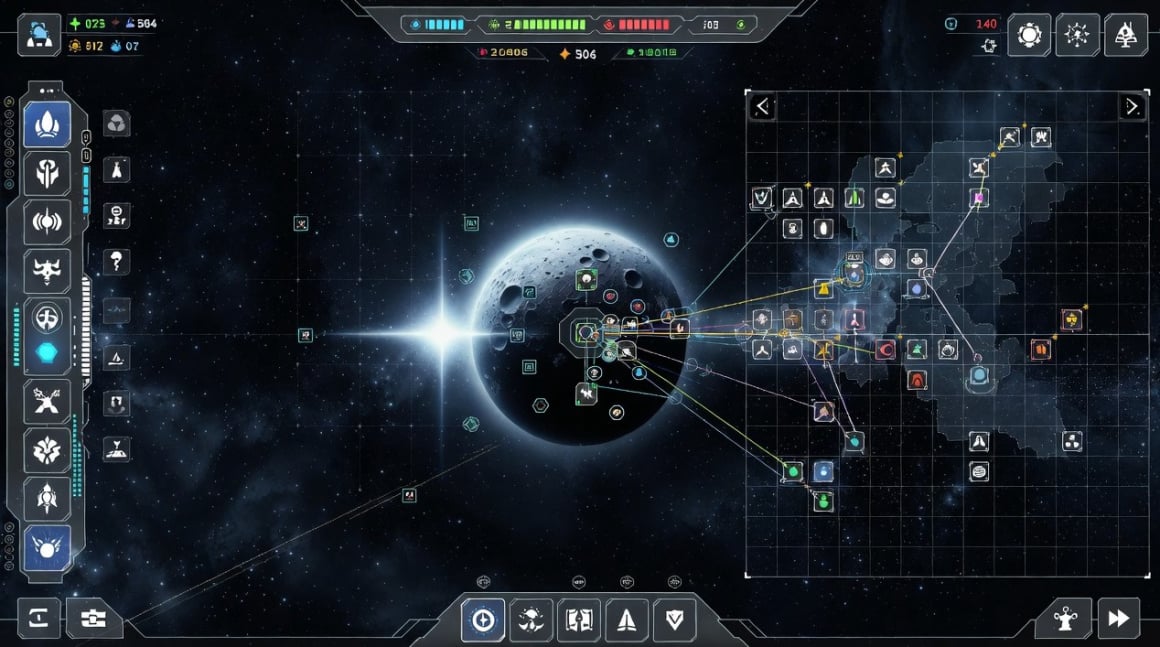
In a market saturated with galactic empires and pew-pew laser battles, "Stellar Fracture" has emerged not with a bang, but with a whisper—a whisper that has grown into a roar within the strategy gaming underground. At first glance, it presents the familiar trappings of a 4X space sim: manage resources, explore the void, expand your territory. However, to dismiss it as just another entry in the genre is to miss the point entirely. The game’s true magic lies beneath the hood, in a deceptively simple faction system that breathes unpredictable life into every single playthrough.
Unlike traditional games where factions are static bundles of stats—"the trading guys" or "the war guys"—"Stellar Fracture" treats each emergent faction as a living organism with a memory. Your actions, however small, send ripples through the galactic community. A faction you helped during a famine might remember your kindness and offer a non-aggression pact centuries later. Conversely, a rival you thought you had annihilated might have scattered to the winds, only to regroup on the fringe of the galaxy with a new ideology born from their exile, solely focused on your destruction.
This dynamic system is the engine for the game's most compelling feature: emergent storytelling. We recently had a playthrough where our pacifist trading federation was forced to build a navy after our primary trading partner was conquered. We didn't liberate them out of altruism, but because their collapse threatened our economy. This single act of self-preservation spiraled into a fifty-year cold war, complete with espionage, proxy conflicts, and a final, desperate space battle that felt more personal than any scripted campaign we've ever played. The game didn't tell us a story; it gave us the tools to live one.
Of course, this depth comes at a cost. "Stellar Fracture" is infamous for its steep learning curve, a fact that has led to some mixed early access reviews. The UI can be opaque, and the sheer number of variables affecting faction behavior can be overwhelming for newcomers. It is not a game that holds your hand; it throws you into the deep end and expects you to learn to swim or be consumed by the cold vacuum of space. This barrier to entry is real and should be acknowledged.
However, we argue that this difficulty is not a design flaw, but a feature. The struggle to master the systems is what makes the victories so sweet. In an era of games designed to be instantly gratifying, "Stellar Fracture" demands patience, curiosity, and a willingness to fail. It rewards the dedicated player with emergent narratives so rich and personal that they feel like memories of actual historical events, rather than just lines of code. The frustration is a crucible that forges a powerful connection between the player and their galaxy.
"Stellar Fracture" is a testament to the idea that procedural generation can be about more than just random maps. It can be a tool for procedural poetry. It proves that the most compelling stories aren't always the ones written by a single author, but the ones that are collaboratively authored by the player and a complex, reactive system. It’s a game that doesn't just offer an escape, but offers a universe to live in, one that continues to evolve and surprise long after you think you’ve seen everything.